Given that Gastronomicom is in Agde and our sommelier from the region, it’s not too surprising that Languedoc-Roussillon wines featured heavily in our wine class tastings and that our two visits were to local domaines. We did cover the Rhone Valley and Côtes du Rhône but tasted only one southern Rhône wine (and only one northern; a Condrieu was badly corked, unfortunately). To redress the balance, I offered to host the wine class in Valréas provided L. and J. (the professional chefs in the group) took care of the cooking. They were more than willing and after only a little cat herding, some phoning around domaines by me and much meal planning, shopping and meal preparation by L. and J., the three of us, A. and C. (the other wine class members) plus K., an interested fellow cooking student, set off to Valréas on Friday evening after time for a shower at the residence.
The two (gender separated!) cars arrive in Valréas by 8pm and after a quick look around and a more leisurely sampling of some Vacqueyras white, the brigade put together a dish inspired by pulled pork tostadas (both L. and I have failed to arrange to have any masa harina, unfortunately), accompanied by some red Vacqueyras.

We then sample J.’s banana, peanut and passion fruit cake deciding, as mentioned in the blog for Friday, that it would be better without the peanut element. After settling sleeping arrangements I head to bed relatively early, having agreed with C. that we’ll head out to collect croissants at 7:30.
A. joins us and we take a roundabout trip there and back along the main shopping streets. The pastry offering at Au Pain d’Antan is interesting to see after a week devoted to making just such offerings and the boulanger is amused to see us taking pictures and then interested when I explain why. The morning is relatively leisurely as our first winery visit, to Domaine Élodie Balme in Rasteau, is not until 11am. We are met by Élodie herself who quickly shows herself to be a passionate and interesting winemaker as she explains in detail how she has converted the 26 hectares previously managed by her father for production as part of the local cooperative into her own organic domain. A tasting of her wines then follows. In addition to Rasteau, Côtes du Rhône Villages Roaix and Côtes du Rhône, we taste the first vintage of a 100% Cinsault vin de France that she is producing in an attempt to convince people that red wines can also be drunk as an aperitif plus two vins doux naturels, a style of wine about which she also hopes to change opinions. After many interesting exchanges, including comparisons between the arts of wine making and cooking, we have to part—we for a quick lunch before our afternoon visit, Élodie to prepare for a hard afternoon’s work in the vines.
Our afternoon visit is to Domaine des Bosquets, chosen because I like their rosé, something I confess to Delphine, our host. After an unscheduled, but much appreciated visit to the cave, she explains that vines were first grown here in the 14th century and that the domaine was owned by the family in the 17th, bought by Eugène Raspail, the Gigondas visionary, in 1861 and then bought back by the family 100 years later. Another tasting follows. I still like the rosé, fortunately. The big disagreements between us are about the single variety wines—there are two grenache, two syrah and a mourvedre, coming from different parcels. There is a distinctly more tannic wine for both the grenache and syrah; opinions differ as to which is preferable. À chacun son goût… We choose to taste ice creams in Seguret rather than further wine tasting at the cave cooperative.
Back in Valréas we have to try Élodie Balme’s cinsault, although C. prefers to continue with last night’s Vacqueyras white as she floats in the pool. L. and J. head quickly to the kitchen, though, where they are ably assisted by A. and K. as they prepare squid tentacles with a mexican salsa and an apple and pineapple risotto (although that description doesn’t do the dish, or their effort, enough justice).
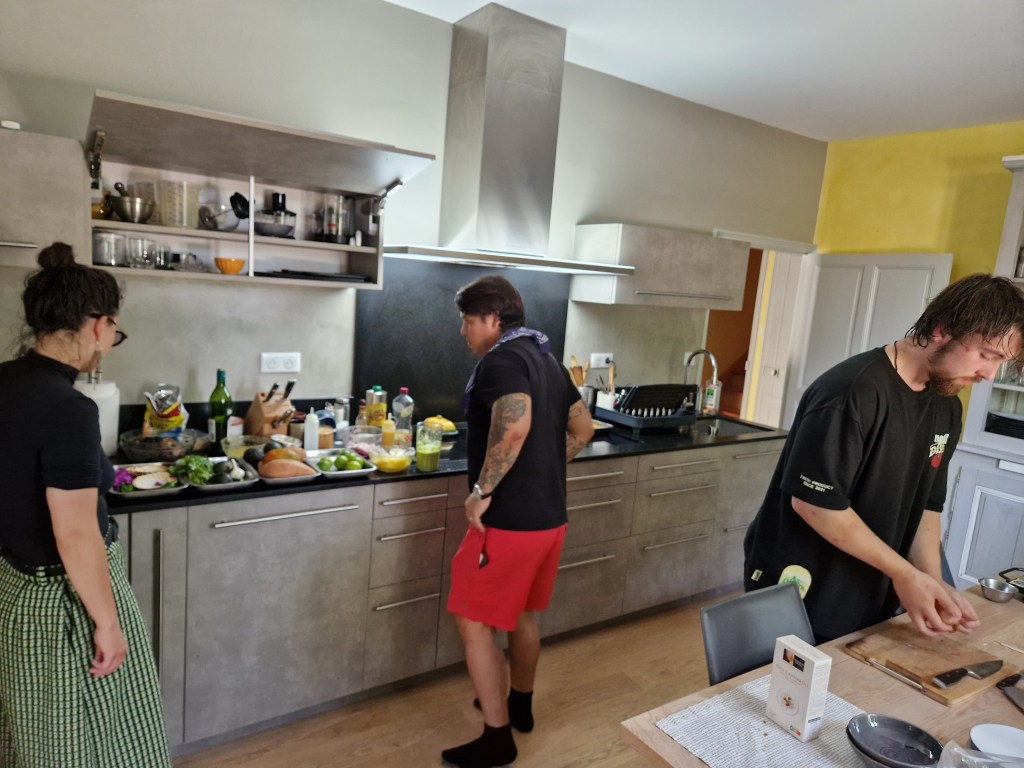

Following L.’s suggestion, the meal is accompanied by more of last night’s Vacqueyras white but the pull of yet-to-be-fully appreciated wines is not resisted for long. We have an interesting exchange on our differing expectations for the course and how these have been met—and, indeed, whether a single course should be trying to meet the expectations of amateurs such as C. and I when L. and J. come in with far more practical knowledge of how a restaurant kitchen works. J. and L. then arrange an impromptu plating course for C., arranging a set of objects on the table and asking her to imagine these as the protein, carbohydrate and vegetable elements of a dish and place them artistically! I don’t try that but I do learn from J. how to make rings of sauce on a plate and how to hold a squeezy bottle properly. I make some attempts to improve my skill at smearing blobs across a plate with a spoon but am sensible enough to realise that I should rather be in bed at 3am…
Sunday’s croissant run had been scheduled for 8am but I’m a lone agent when I set off at 8:30. C. joins me for tea just after I return and the rest of the party appear gradually before we head to the olive oil cooperative and museum in Nyons. After huevos rancheros for lunch, L., J. and the brigade prove as assiduous as the Gastronomicom chefs would expect in the cleaning of the kitchen whilst I look after various other tasks. After a detour along the route to Le Pegue for pictures of lavender fields, we head to Domaine Villeneuve to sample some Chateauneuf-du-Pape. Our host, Stanislas Wallut, is a little surprised to see us arrive but, once he finds he just hasn’t been told that our visit has in fact been arranged, proves to be every bit as welcoming and helpful as Élodie Balme—who he happens to know and respect. Burdened by our purchases and a magnum of the wine Stanislas makes by blending his wine with some from two like-minded vignerons in the northern Rhône, we head back to Cap d’Agde, L. and J. planning a menu to accompany the magnum…

 Food in Provence (and elsewhere)
Leave a comment