The decoration of the banana, passion fruit and peanut cake wasn’t as complicated as I’d feared. There were lots of steps, none of which were that difficult in themselves, but precision was needed—precision that was lacking for me today, notably at a key stage… The first step was to whip the ganache montée we’d prepared the other day and pipe multiple blobs in a 14cm circle. After they were blast chilled, I spray painted these yellow and they were dusted with vanilla powder to represent the banana seeds.
Meanwhile, E. was melting the yellow glaze prepared even before the ganache and then cooling it down so it was still runny but not so hot it would melt the bavaroise. Actually coating the cakes was easy if you were determined: pour the glaze in a steady stream aiming at the centre of the cake initially and then moving out so it ran over the edge—which needed to be lightly rounded, not left square, so the glaze could run off evenly. After lightly brushing off excess glaze with a palette knife (the chef emphasised the glaze was mostly sugar and gelatine, so not the most flavoursome feature of the cake…), we left the glaze to set for a while and cut off the drips from the bottom edge with a knife. There’s a fine line here: you don’t want to cut into the glaze but you do need to make sure you cut the glaze completely flush with the bottom of the cake to stop it bulging out when the cake is placed on the presentation disk.
The spray painted ganache disks were then transferred to the top of our cake with the aid of toothpicks. The toothpicks, though, were only supposed to be used to pick the disks up until they could be supported with a palette knife. Luckily, mine didn’t fall off the toothpicks as I forgot that safety precaution.
I was not so lucky with the chocolate band to go around the cake. This band was made in the same way as the smaller bands for the cheesecakes last month—spread tempered chocolate on an acetate strip, leave it to start setting, mark a diagonal line, roll round a ring and leave to set fully in the fridge—but with milk chocolate rather than coloured white chocolate. More relevantly, the ring was bigger and we were making only one, not three. As each acetate strip gave two halves, split along the diagonal, we could mess up one acetate strip for the cheesecakes and still have four spirals, enough for the three cheesecakes. Here, though, there was only one. And, of course, I messed it up by spreading the chocolate too thickly so it never really set properly and so stuck to the ring. I wasn’t even saved by E. as our chocolate had cooled down too much and so wasn’t properly tempered when she spread it on her strip and thus cracked when taken off the strip later.
Fortunately, the expert pastry chefs across the bench had each made two perfect spirals and were willing to pass their spare ones across. After adding final touches on top, time for a trip to the photograph room.

The conclusion of the Valréas wine party was that the cake would have been better leaving out the peanut element. Still, our neighbours there were delighted to be given my specimen on Saturday morning (we’d cut into J.’s for our tasting) even if I did say I wasn’t that keen on the taste.
Something else the Valréas wine party agreed on was that the squid carbonara recipe we all made in cooking class (only J. and I take pastry class as well) did not benefit from the pea and confit onion embellishments. The squid carbonara itself was quite good (although Italians would recoil at the inclusion of cream) and made essentially as you’d imagine, by using finely cut strips of squid instead of spaghetti. The two good embellishments were an egg yolk cured in soy sauce and a thin, crispy tart case made from a pasta dough baked between two tart cases. (And for that, I was not best pleased by my partner using the rest of my half of the dough to make nacho chip-like things for his dinner; it meant I had to rapidly roll out his half to make a spare tart case; I’ve learnt that having a spare is always a good idea if you can…) The pasta dough included some buckwheat flour so a fifth embellishment was some deep-fried cooked buckwheat for an additional crisp element. The wine party was neutral on this.
The pea element was actually two-fold: blanched peas and a purée made from the peas cooked in cream. The onion was first cooked in red wine with star anise and cardamom and then cut in half and crisped in a frying pan on the cut face.
Plating was free, and here’s mine…
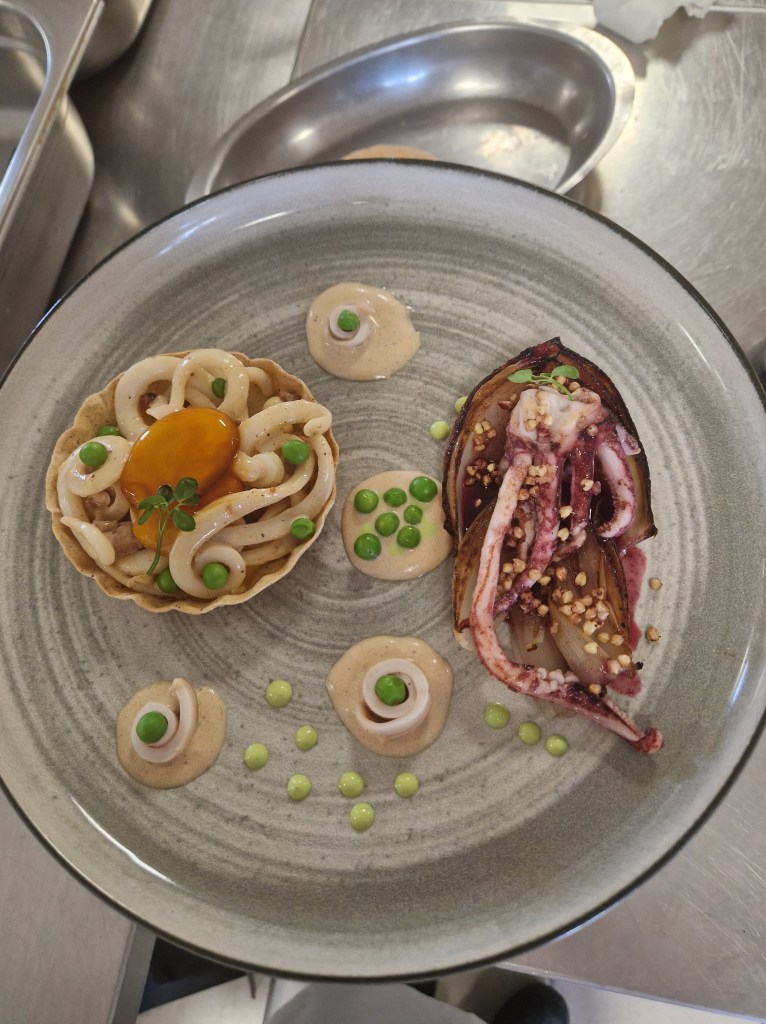
… which would have been vastly improved by leaving off my additions as well as the blanched peas. I was greatly comforted by the discussion over dinner in Valréas: none of us were really happy with what we presented, all feeling that there were too many elements to the dish.


Leave a Reply