… literally! I wrote on Tuesday that there were five teams for the choux workshop and that we each prepared one choux filling five times. But I woke in the middle of the night realising that we had only used four yesterday. So what hadn’t we used? Had Chef made a mistake? I had to ask him. He pointed out that there were in fact only four teams and four fillings: the fifth mise en place was for him! Mystery solved.
The early start this morning meant some people missed our fun with the spray gun. This was the compensation for the difficulty of tempering the white chocolate and coating and then sealing the moulds: the decoration was more interesting—Chef pointing out, in fact, that this is the principle interest in using white chocolate: the scope for colourful decoration.
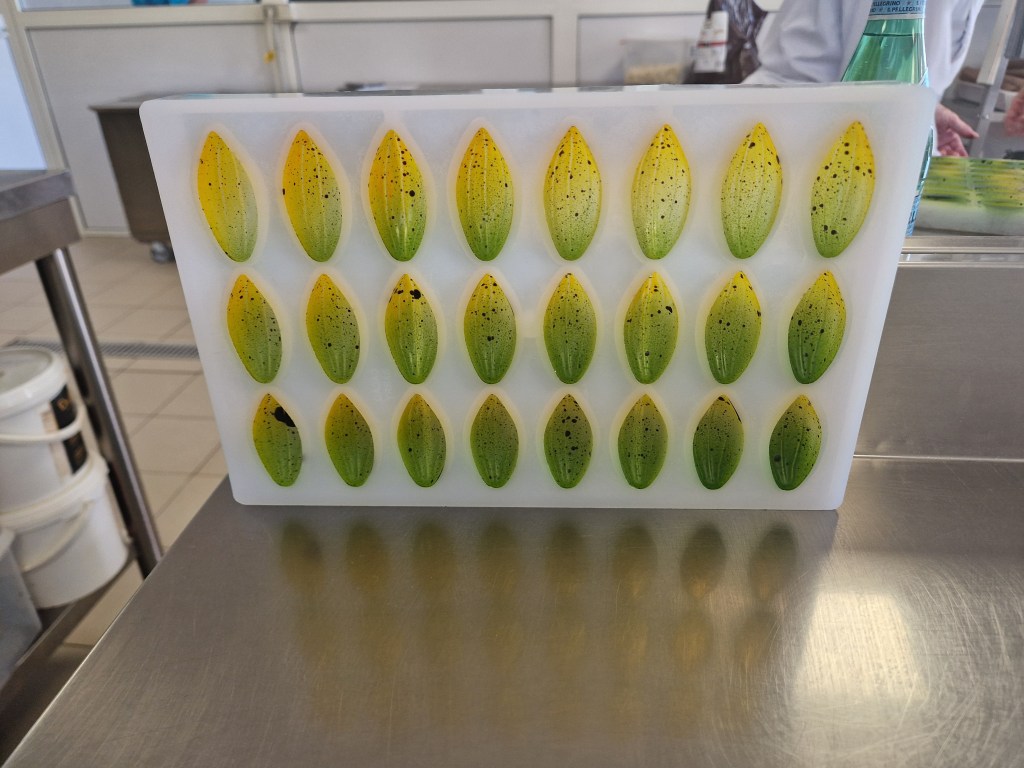
Our mould for a banana and rum chocolate was first toothbrush-splattered with black-coloured cocoa butter and then given a yellow and green two tone decoration with the spray gun.
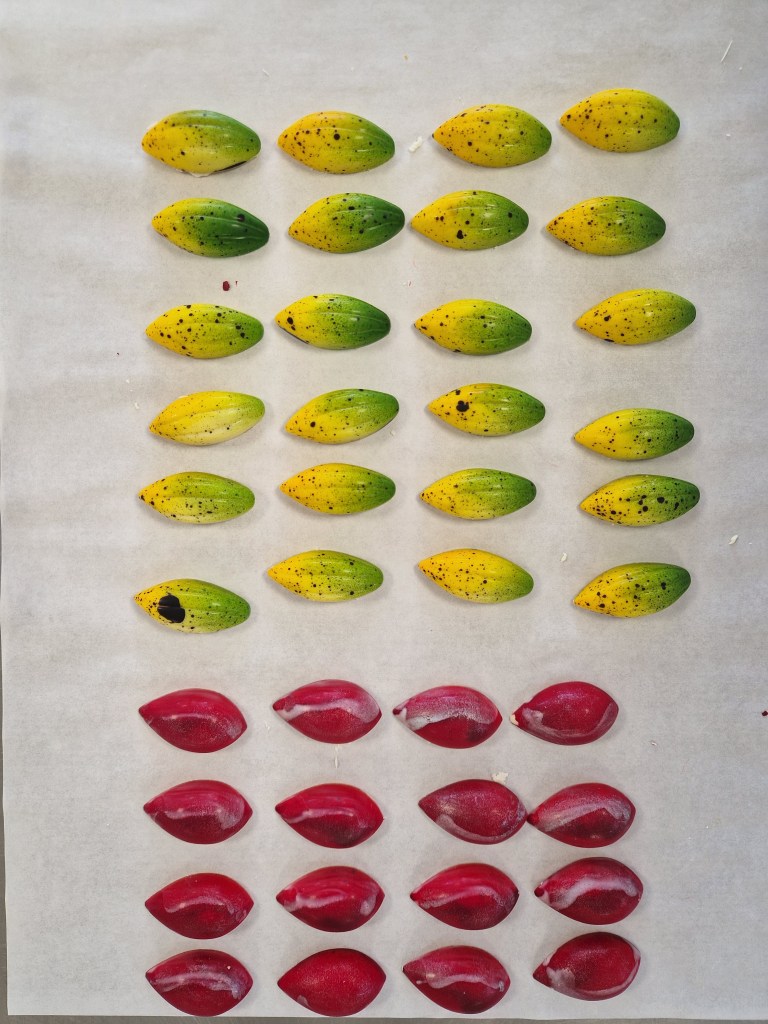
Then a mould for gianduja chocolates was decorated with a (glove covered) finger swirl of white cocoa butter, brushed with silver powder and then spray painted red. Much of this was done by E. while I tempered the white chocolate, the inverse of our tasks yesterday. I did get my turn with the spray gun, though, although I was too quick for E. to film me in the act.
Luckily no-one was filming us as we coated the moulds; way more difficult than for the dark chocolate but we managed OK; part of the test is how easily the chocolates come out and ours pretty much fell out of the moulds at the end of the lesson. A few might not look so pretty on the bottom, but you wouldn’t know from our photographic evidence. They are filled, by the way, with. respectively, banana, lime & rum ganache and gianduja ganache. The ganache won’t keep so well if it isn’t securely sealed in. So I have to look through my share of the chocolates and eat the substandard ones. Such a hard task…
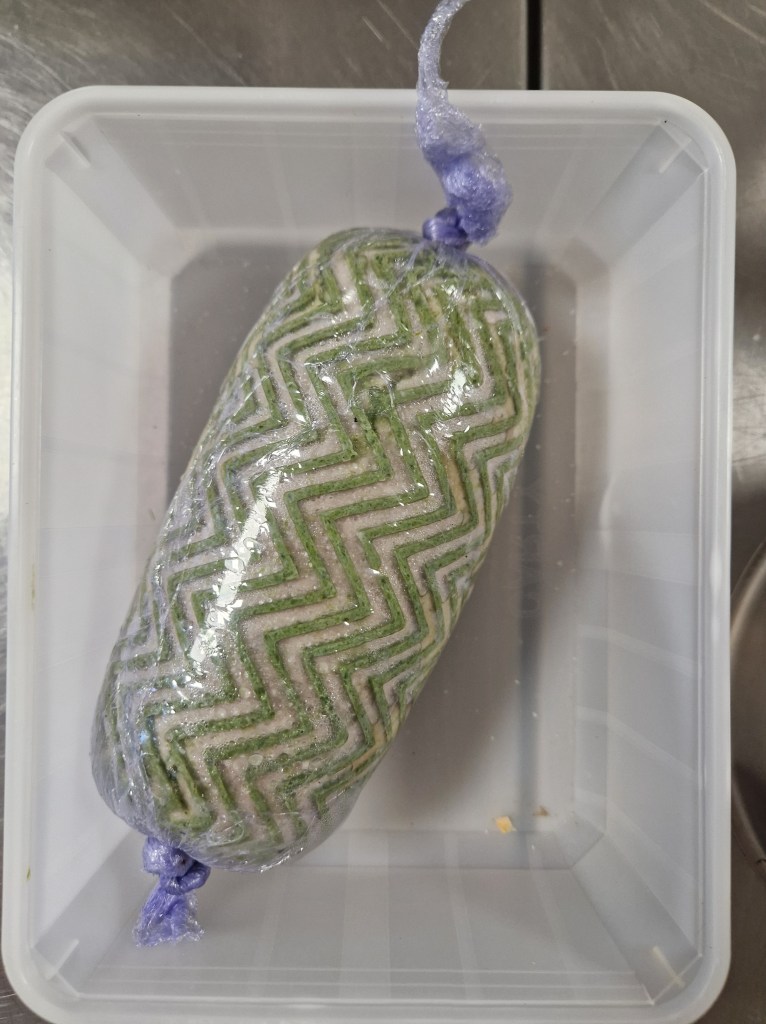
The cooking task was to prepare a Wellington-style pork tenderloin. Again, my professional colleague did the fiddly bits but I was learning along the way—his method of removing the silverskin from the tenderloin was way more efficient than Chef’s demonstration. And I was also grateful that he took on the hard task of passing the stuffing mixes through the tamis, with me just handling the blending of finely chopped tenderloin, cream and egg white in the mixer. While he smoothed the stuffing mixes (wrapping mixes, really), in the mould and cooked them, I prepared the mushroom duxelles for the final layer and prepared the sauce. The centre portion of the tenderloin was then rolled in the wrapping, wrapped tightly in cling film and steamed for 20 minutes.
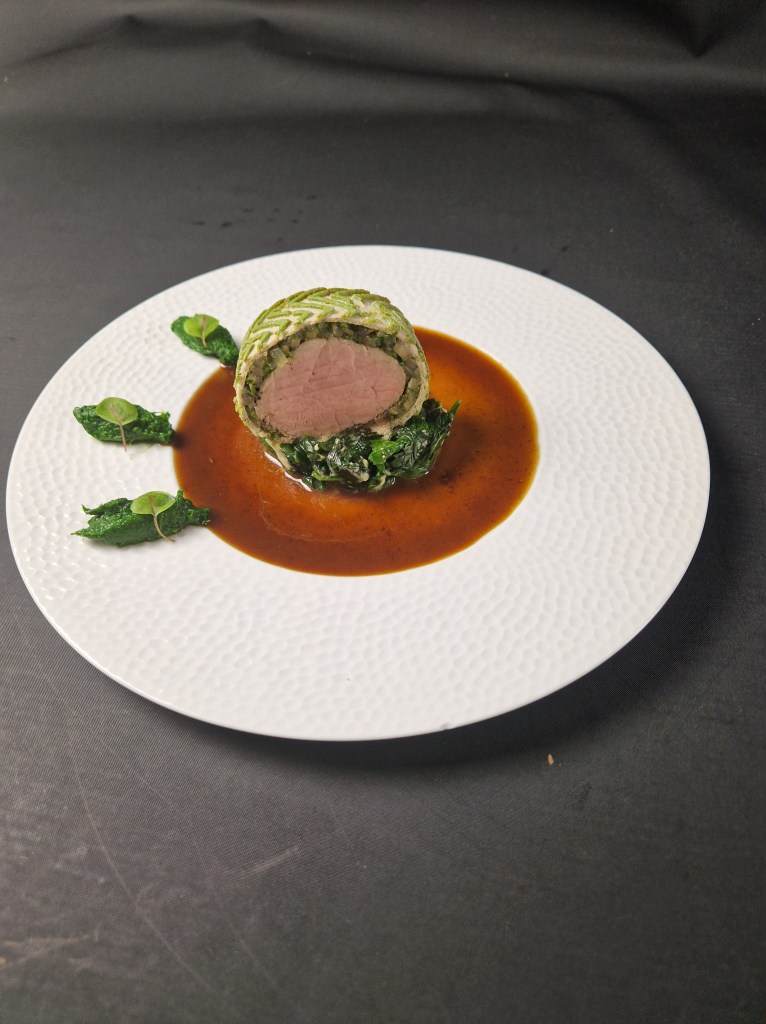
Then it was time for plating. The basic set up was shown by Chef but we were left free to improve the presentation. I’d remembered that we had, during the class, prepared a “chlorophyll”; a deep green paste made by blending cooked parsley. I asked Chef why we weren’t using this, only to be promptly given a pot of the mixture and pretty much dared not to use it. He liked the idea of my presentation, but the execution fell short of his expectations so I had an impromptu lesson on forming perfect quenelles. I will need to remember; he will not forget!
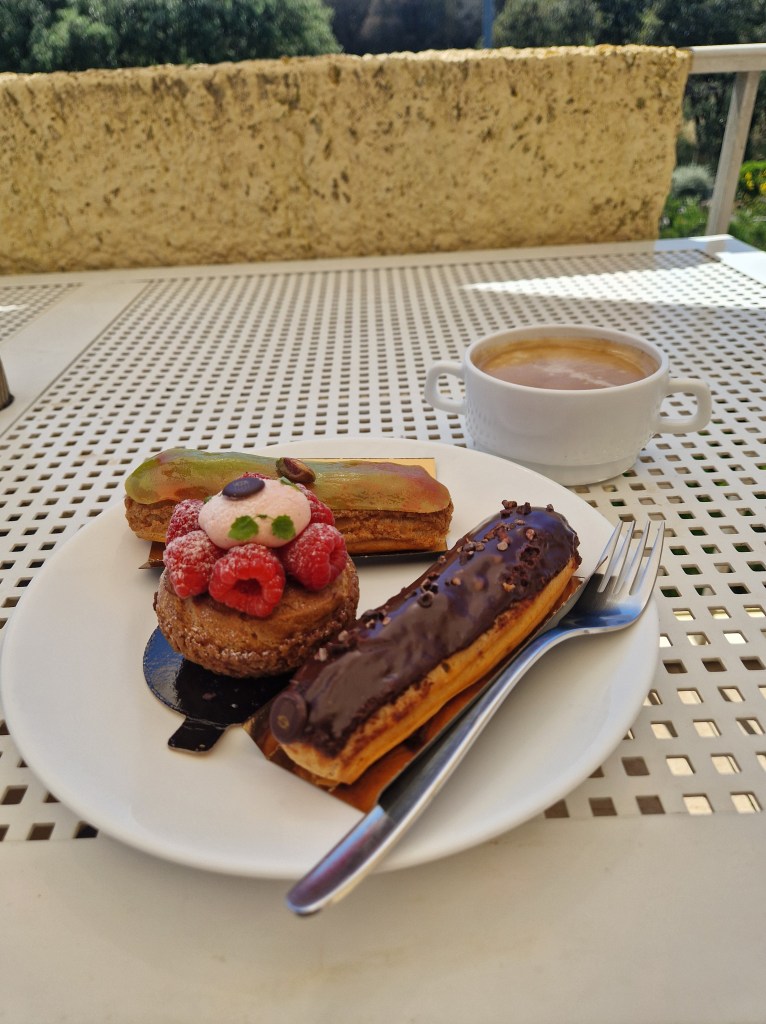
It might be a holiday, but the supermarket was open, luckily, as I needed supplies, not least to make another batch of yoghurt. But the early start meant there was time for a sumptious goûter.
 Food in Provence (and elsewhere)
Leave a comment