My prediction of a plating exercise for pastry yesterday was correct. But the two first tasks were also a challenge, especially the second. The first was to prepare a jelly for the lemon/verbena dessert. This was simple in that all we had to do was prepare an agar-agar based jelly flavoured with a verbena liqueur. We all know by now that agar-agar needs to be boiled for at least 15s if you want it to set, but now we have to pour it into an 18cm square mould. Chef does this by himself. K., who made the gel, prefers that I push the mould down firmly to be sure nothing leaks out. She needn’t have worried, but others should have and a few second batches are made.
Then it’s my turn for the active role. I have to prepare a fromage blanc mousse for tomorrow’s dessert. The recipe has two steps noted. Watching chef I note 14! A fair few are steps to prepare a pate à bombe, which is made like an Italian meringue but with egg yolk, not egg white. I think all is OK and we end up with 6.5 of our moulds filled, although I later manage to send one flying across the floor (taking them out of the moulds was not at all easy, even if chef made it look so). Luckily we only need two, apparently.
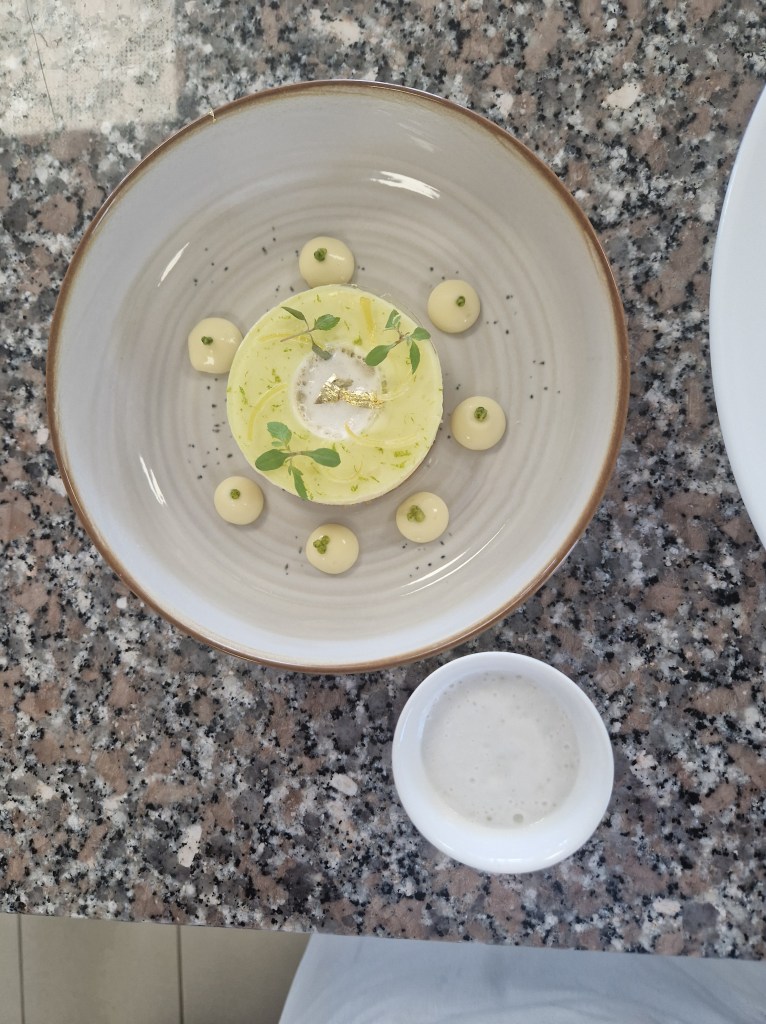
Meanwhile, K. was cutting rings from the square of almond cream that was baked on Monday and then topped with the lemon and yuzu cream yesterday and putting these on rings of the lemon sablé, the making of which I’ve skipped over. Chef then tells us we need to plate precisely one of these sablé, baked almond cream and lemon/yuzu cream squat cylinders using seven or eight different elements—the verbena gel, left over lemon/yuzu cream from yesterday, candied lemon peel from last week, cress, gold leaf, some patisserie lime coated crumbs and a siphoned mousse he’d prepared (note that point!).
I am the one person who decides to take a round bowl. I cut a disk of the verbena gel to put on top of the sablé/almond cream/lemon&yuzu cream cylinder and beat the left over lemon&yuzu cream to pipe dots around. These do not turn out well. Prompted by chef, I take a new dish, transfer my squat cylinder, re-work the cream and am this time happy with my piping. After careful placing of the lemon peel, cress and crumbs, the plan for a nice siphoned mousse middle topped with gold leaf collapses. Literally. Chef rescues us all by suggesting we pipe the mousse into small bowls to serve on the side. And he likes my plating!
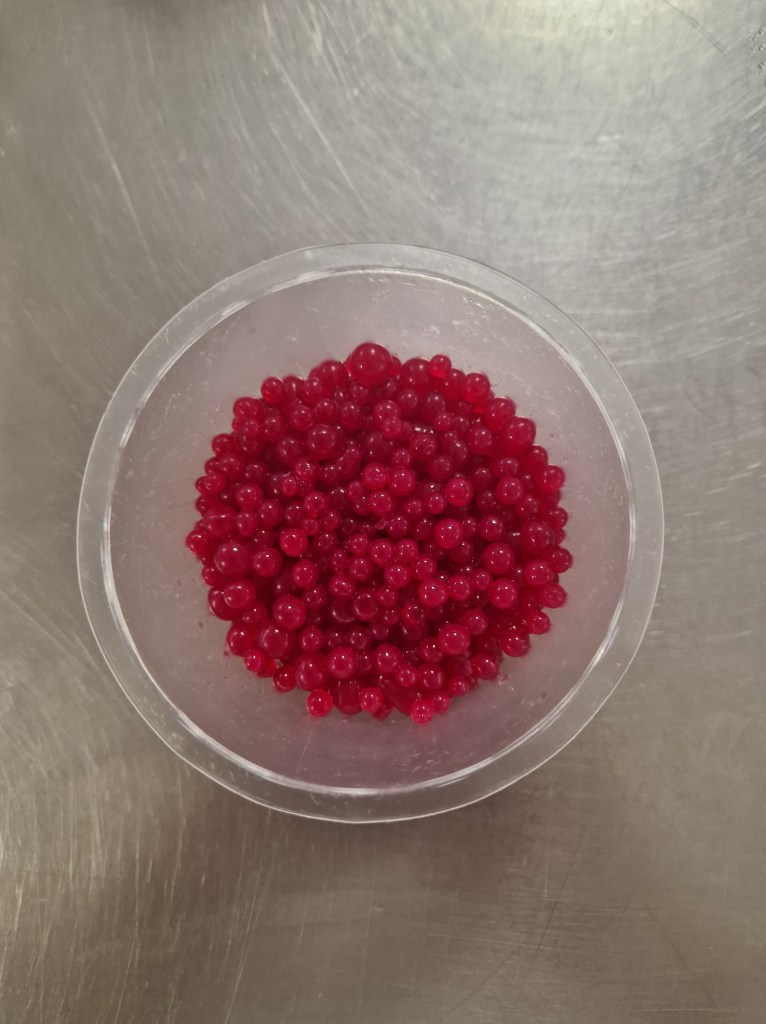
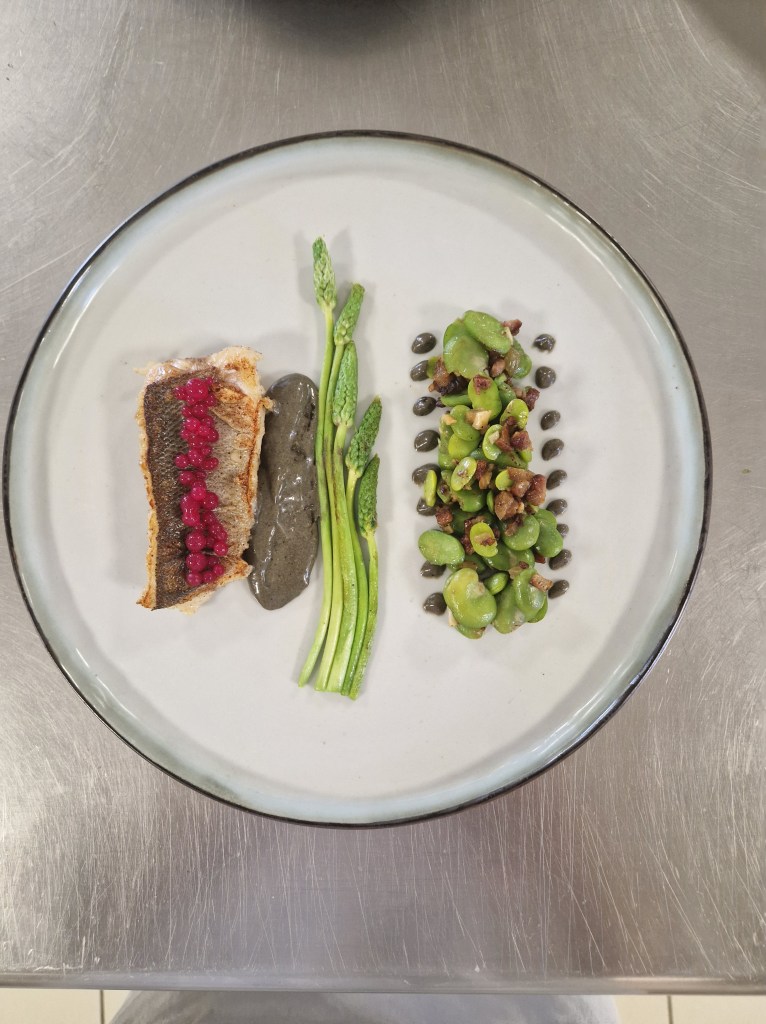
In the afternoon we have to plate a sea bass fillet cooked slowly in butter accompanied with fava beans and wild asparagus with a black garlic mousseline sauce and red cabbage pearls. I, with some help from chef, progress in my fish filleting skills and, with encouragement from M., who is well practised in this already, produce a respectable quantity of reasonably sized pearls. This is done by preparing another agar-agar based gel mixture, cooling this to body temperature and sending a stream of drops from a squeezy bottle into very well chilled oil. M. took pictures of me doing this but all I have is one of the final result.
Along the way we’ve prepared the black garlic mousseline (me the easy bit in making the black garlic oil, M. cooking the eggs and bringing the sauce together), and cooked the fava beans. The last steps are to cook the wild asparagus (briefly!) and the fish (slowly, basting regularly with butter). For the fish, chef shows us how to fit large fillets into a small pan: cut the skin off the tail end and fold this under. Easier said than done, I can tell you!
So, the plating. One thing I learnt is to never try to corral fava beans in a mould. Overall, though, I think I’m progressing but, whilst chef is happy with what I’ve done, he wants me to be less a physicist and more an artist…
Then our final wine class. It’s good the Sauternes, a premier grand cru classé, was left to tonight as it is a good match to the left overs of the lemon verbena dessert that two of us bring to class. The next wine, though, A. and I find undrinkable. It’s a 100% Languedoc-Roussillon sauvignon blanc, but it’s an orange wine, even if it looks like a white. Our sommelier thinks it could be a good choice to accompany some chicken dishes but A. and I remain unconvinced, even if some of our fellow students are happy to finish their glasses.
Then another test: a blind tasting of two reds, which we are told are both single varietals. On smell and sight, I hesitate between Languedoc-Roussillon and Cotes du Rhône for the first before settling on the latter. A. is for the former, others favour Bordeaux or Burgundy. Tasting, I figure a Syrah from the northern Rhone. A. is right to stay with Languedoc-Roussillon, although neither she nor the others identifies the Carignan grape. For the second, most favour, on smell and looks, Burgundy for a pinot noir, but I’m not convinced so suggest Beaujolais. Tasting, though, it is obviously not so I join the Burgundy crowd, albeit reluctantly. It turns out to be a pinot noir from Languedoc; we should have guessed our sommelier would pick wines from her favourite region!
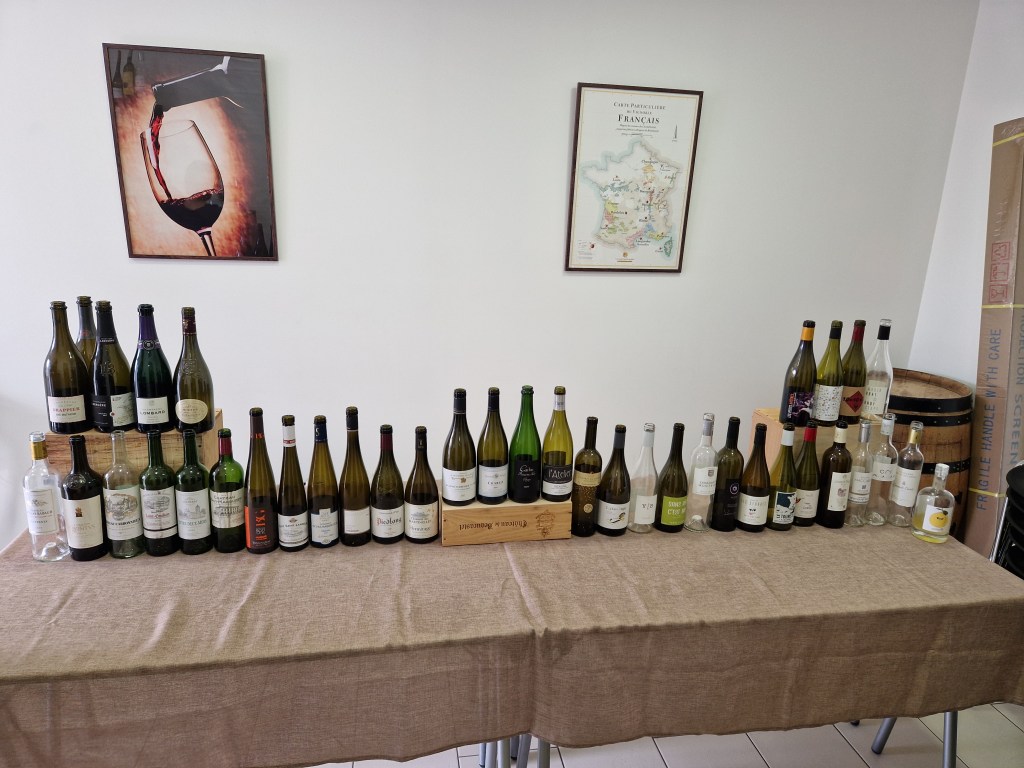
We end our class by lining up the empties for a photograph. Or most of them; some not-quite-finished bottles having been taken back to the residence for further testing…
 Food in Provence (and elsewhere)
Leave a comment