Delivering a plated millefeuille to the customer, chef, was the goal of the morning. And it required a fair bit of effort from me…
B. and I start off smoothly enough. We find her left over puff pastry from the apple turnovers (I figure hers is likely to be better in terms of both quality and quantity than mine…) and a joint effort produces a rolled out strip that is at least 18cm wide all the way along. Into the oven it goes. Chef then shows us that he is making a batch of peach and ginger confit for all of us but tasks me with sharing it between two large containers and blast-chilling it until it is cold. He also asks B. and I to make opaline—heat sugar and glucose to 150°C, spread into a thin layer on parchment paper to cool and then blitz to a powder. That sounded easy enough but he comes back a little later with 4 stencils and asks us to spread the opaline into these and bake it. That again didn’t sound too difficult, but B. sifts most of the opaline onto the stencil-covered baking sheet without managing to fill the stencil blanks. I realise the way to do this is with a bent spatula and work at spreading the opaline into the blanks whilst B. makes a pecan nut crust (a pecan flavoured sablé, essentially). Filling the blanks in the stencils takes a while so a) the stencils don’t come off evenly and b) the opaline has leaked out under the edges in about half of the comma shapes. Chef says to bake anyway and see what comes out of the oven.
During the baking time chef shows us the pine nut dough he made yesterday (something I forgot to mention) and how it will be baked in a pain de mie mould (one that has a closing lid). The essential point here is to butter the mould (and lid) twice to be really sure it is properly buttered—so brush once with melted butter, put the mould in the fridge for a few minutes then repeat.
Back to the opaline and the picture is not good. There are 80 comma shapes on the silpat and fewer than half are useable. In principle there should be enough for both the morning and afternoon classes but, as I’ve mentioned, having spares is always useful—only just enough is not good enough. So, after hesitating for a bit, chef suggests I bake another lot. The first step is to wash the stencils and dry them in the oven for a few minutes. This give me time to watch chef walk us through the preparation of creamy peach half-spheres for plating—a task undertaken by B.—then I start on filling the stencils again. Working with the bent spatula from the beginning is way easier: sift on some powder, smooth it across the stencils, adding more when necessary. It’s also way quicker which means the opaline hasn’t stuck in the stencil blanks and, with less faffing around, hasn’t leaked under the stencils either. This time I end up with well over 70 useable comma shapes.
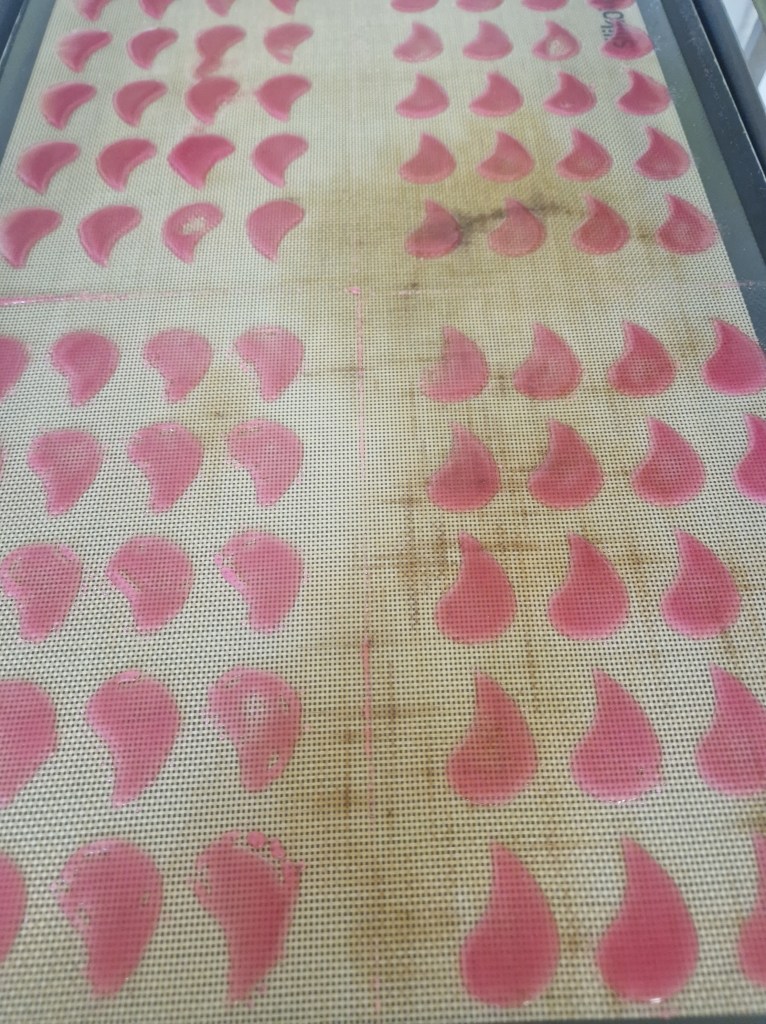
Meanwhile B. has cut our baked puff pastry into eight 3x15cm strips, enough for two millefeuilles each, whipped our vanilla crème onctueuse into a pipeable consistency (I think this is another preparation we made yesterday that I forgot to mention) and, while I clean all the sticky pink powder off our bench, B. whips up a chantilly cream and cuts thin slivers of crystallised ginger. Time for assembling the millefeuilles and plating.
We pipe the crème onctuese around the edges of one puff pastry length, fill the centre with the peach and ginger confit, top with another strip of puff pastry and place the assembled millefeuille on its edge, piping waves of chantilly cream along the top with a flower nozzle. To plate, the “easy” part is to pipe a zigzag of the confit on the plate, cut the millefeuille in two, place securely on the plate and decorate with stem ginger and edible flower petals. Then we add our peach purée half sphere after dipping in a vegetarian jelly mix and, finally, add a quenelle of ginger sorbet. Previously we’ve used sorbet or ice cream frozen into quenelle shapes. Here we have to make our own from the pacojet containers with a spoon. Chef shows us how but says we are allowed only three attempts: the sorbet melts quickly so our third quenelle has to be plated, however successful. I’m pleased enough with my second try, as is chef—although he thinks I should have placed the millefeuille a little more centrally on the plate.
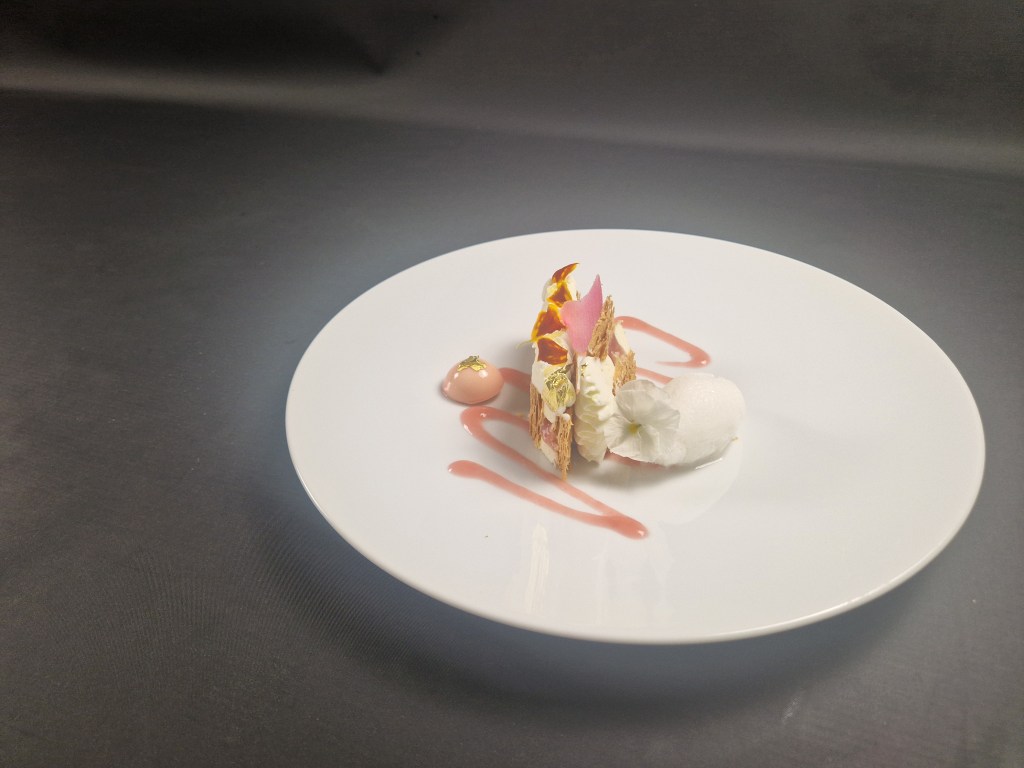
The ginger sorbet was excellent and the millefeuille quite acceptable. Certainly acceptable enough for me to have two for goûter as B. didn’t want to take her spare one.
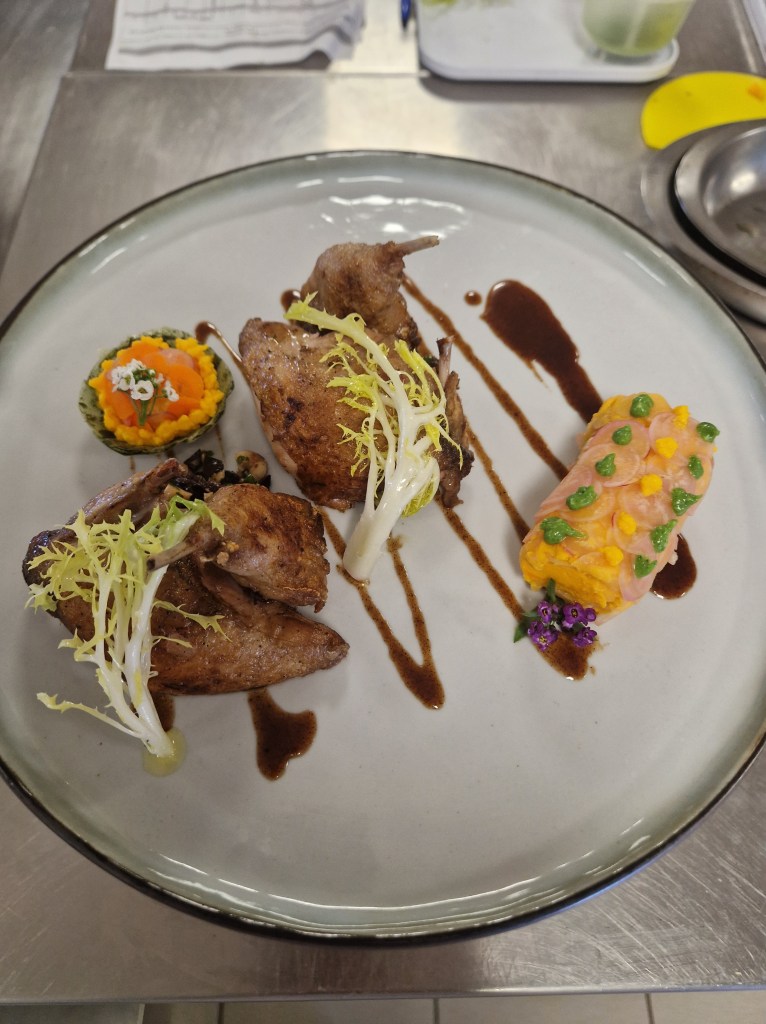
The challenge for cooking class was to prepare quail with a carrot dome tartlet and a radish-covered carrot cylinder. TLDR: preparing quail is fiddly, but nowhere near as fiddly as preparing a radish-covered carrot cylinder. The quail were cooked on the crown, something I’ve done with pigeon often enough—and the size isn’t so different. For the carrot cylinders, we first boiled carrots in water, then cooked them briefly in cream with added agar agar and, after blending, piped them into cylinders of plastic film secured with sellotape and also some half-sphere moulds. These went into the blast chiller for a while. Along the way, we’d also finely sliced radish and some carrot with a mandoline and then blanched them. It turned out later that they had been sliced rather too finely as they weren’t really thick enough to provide an evident radishness to cover the de-tubed frozen cylinder. The covering process was to arrange a rectangle of radish slices on clingfilm, add some of the blended carrot as a glue (I probably [certainly…] added too much) and roll this around the cylinder. Chef’s model had a whitish appearance; mine was very orange as the radish disks were too translucent. The half sphere was covered more successfully in disks of carrot and (carefully chosen) radish and placed in a tart case made from folding filo pastry in two over a parsley powder filling and baking circles, as we’ve done before, between two tart cases.
Along the way we prepared a sauce, using the remnants of the quail carcass, and an olive, hazelnut and lime mix. Our task was to emulate chef’s plating again, something I did reasonably well. I wasn’t that enthusiastic about the plating, though—or maybe just the radish-coated carrot cylinder—and it showed as I didn’t add enough cheffy touches around the tart or on the cylinder. The quail itself, though, should taste good for dinner. And, thinking now, I’d probably be happier plating this with the tart case filled with the meat from the legs together with some purée—possibly pea as I think a green colour would be better visually than the carrot orange.
After a quick trip to intermarche for J. to buy ingredients for a meal tomorrow—A.’s birthday and we need to try the magnum of the trois barbus wine offered by our host at Domaine de Villeneuve—back to the residence for a blog entry, yoghurt making and homework for the tests at the end of the week.
[And on the subject of homework, I went through yesterday’s list of sponge recipes and methods given by our pastry chef last night and was puzzled by the instructions for a dacquois sponge—whip egg whites, add sugar…—and a succes sponge—whip egg whites and sugar…—as the recipe for our grapefruit Dacquois cake we made in our first month told us to whip egg whites and sugar and then … I asked chef about this and it turns out that a Dacquois cake is made with a succes sponge! Not logical, he agreed, but to do with the ratio of sugar to egg white: for the success sponge mix for the grapefruit Dacquois cake the weight of sugar was equal to the weight of egg whites; the amount of sugar for the dacquois sponge for our croquant noisette last week was only 40% of the weight of the egg whites.]
 Food in Provence (and elsewhere)
Leave a comment