The Gastronomicom workshops are definitely more relaxed than the regular classes: fewer students (just six today) and a focus on a particular subject. The chefs even take on a fair fraction of the cleaning to give us more time to practice and learn! We start early today but with a welcome breakfast of coffee and croissants before the one theoretical lesson of the day: a treatise on the different sorts of gelatine (with an explanation of the bloom rating and the amounts needed per litre) and a comparison with agar-agar, kappa and xanthan gum. Along with the theory of the ingredients, chef also gives a lecture on the realities of use in a professional kitchen. A lone chef can know precisely how much (little…) they want to use to achieve the desired result but can’t be sure how all the chefs in a team will interpret and measure the amounts, thus recipes usually err on the safe side even if this results in a gel that is stronger than necessary…
Anyway, time for our first practical experience of using agar-agar to set liquids we form into cannelloni, lentils, grains of rice, little cups, … Our gel is flavoured with soy sauce, but—as chef explains—the possibilities are endless and limited mainly by our imagination. Playtime over, we are set a more useful task: preparing a molecular spaghetti carbonara. My role in this is to prepare the “spaghetti”, something I do by infusing a milk and cream mixture with parmesan, mixing the liquid with agar-agar, cooling it a little, sucking the liquid into metre lengths of thin piping with a syringe, plunging them into an ice bath and then using the syringe to eject the spaghetti-like strands into an oiled container. Unsurprisingly, it didn’t go exactly as that summary suggests. In particular, I wasn’t working alone and we moved between the different tasks. This meant some of the tubes were left in the ice bath for longer than necessary and considerable force was needed to eject the strands from the tubes. Hands alone couldn’t squeeze the syringes hard enough so I have bruises on my chest and stomach that bear witness to the force needed!
The easiest task was to cure egg yolks in soy sauce; the hardest part of this is to ensure the yolks are perfectly separated from the whites. The third task was to prepare a bacon mousse to be served from a siphon. Not as physically hard as producing the spaghetti, but the most complicated in terms of cooking (but really not that hard).
These could sit a while giving time for chef to talk about the different methods of spherification and explain how to make rollable gels (tomato in this case) that could be used in various ways, including as another cannelloni variation. We prepare olive spheres (discs, rather), and feta-filled tomato cannelloni. My cannelloni always seem to crack rather than roll neatly. L. implies I’m ham-fisted but chef notes I’m working with a sheet that hasn’t been spread thinly enough. Even so, this leads to another interesting conversation about the need to have a mix of skills in a kitchen echoing much I learnt in management courses at CERN about the need for a balanced team—too many perfectionists will never complete a task on time, but you need at least one; too many inventive people are unlikely to deliver the specified result but without at least one you’ll never find a smart way of getting there…
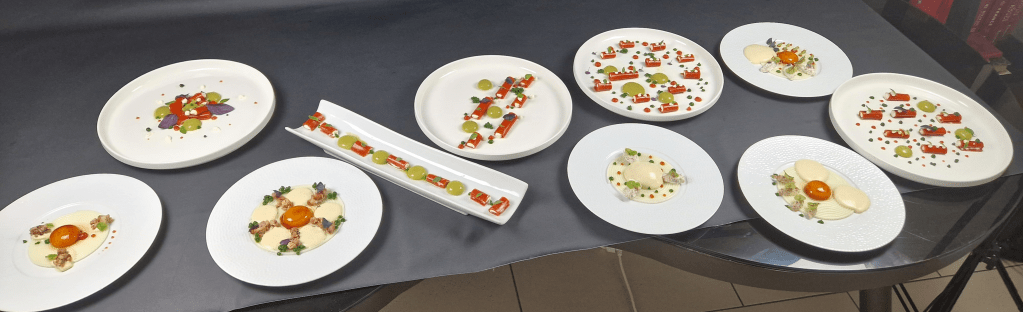
Then it comes to plating. We start with the tomato/feta cannelloni and olive spheres. I’m the one person to interpret this as an aperitif offering rather than a meal course, so choose a rectangular plate and a “physicist” ordered offering. Chef understands where I’m coming from even if my placement could have been more precise. We are shown the base of the plating for the “spaghetti carbonara”, a spaghetti spiral covering the centre of the plate. Everyone chooses the obvious placement for the cured yolk… Chef finds himself liking mine (to the south west of my cannelloni and olives in the picture) despite his initial impression there was too much bacon.
We eat our plates outside with a glass or two of Brouilly…
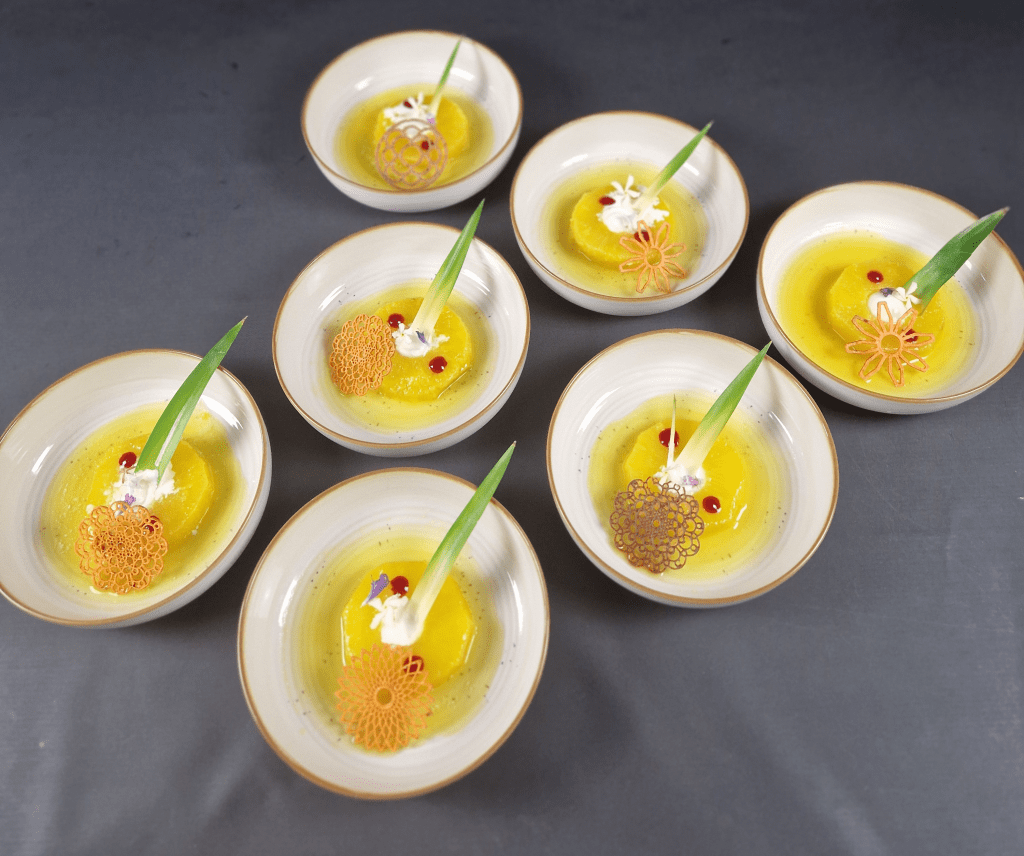
Then there are a couple of things I’ve actually done at home myself: fizzy orange segments and “cooking” pineapple rounds in syrup using a vacuum sealer. L. plates the pineapple dessert (see later for the orange segments) but neglects to tell us the crispy tuiles are left over from his test yesterday. Mine tastes of turmeric which does not complement the pineapple at all!
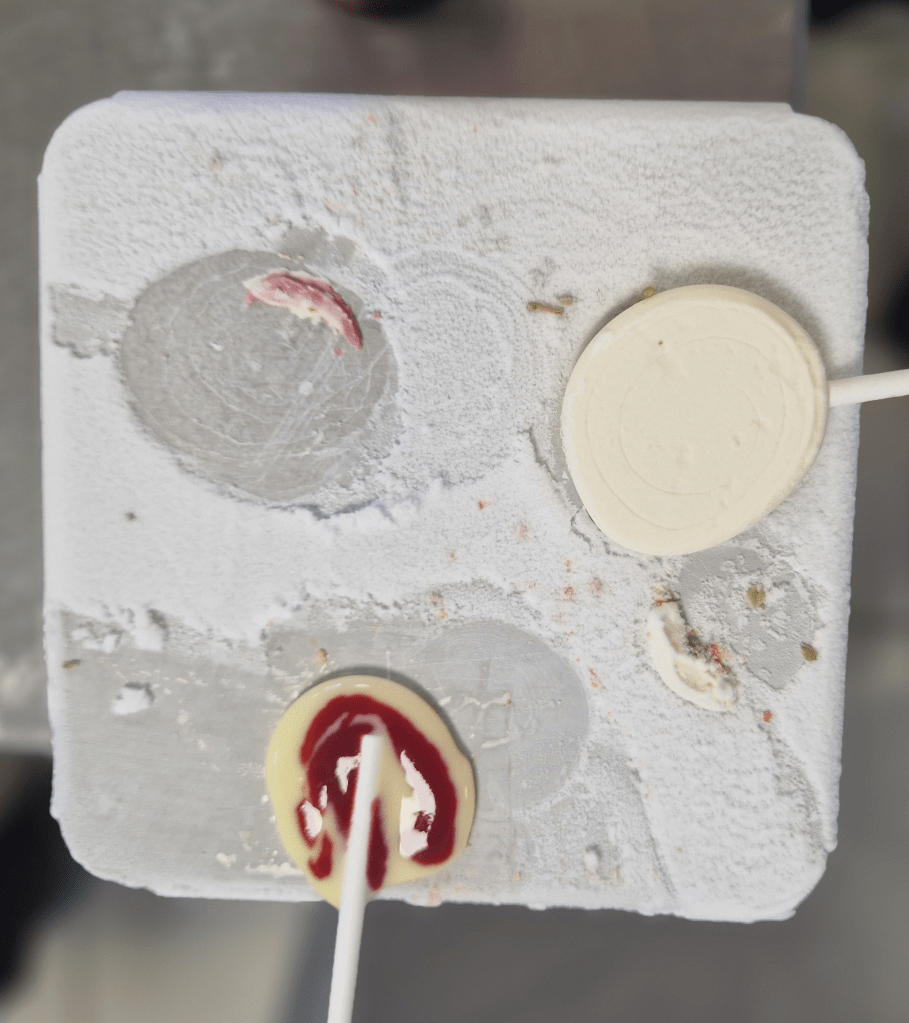
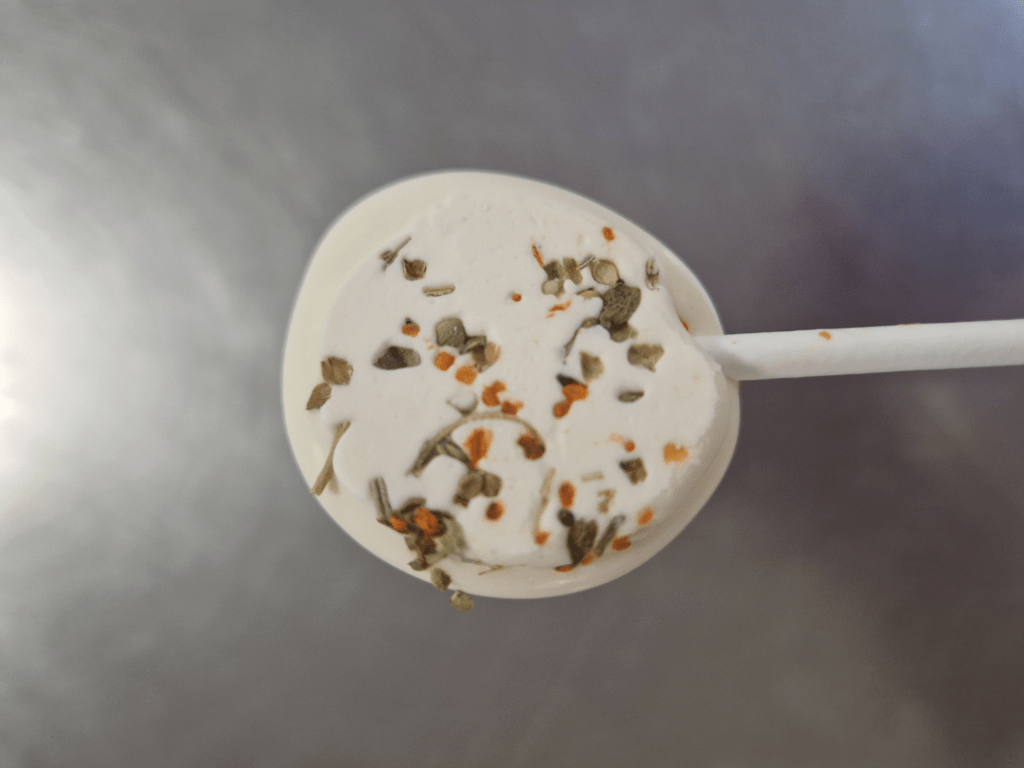
On to things I definitely won’t be able to do at home, but much of which I’ve seen demonstrated at CERN, especially at Open Days: preparations with liquid nitrogen. We have the usual sorbet and ice cream (delicious!) and also a cheesy popcorn made by using a siphon to put a parmesan cream mix into liquid nitrogen to expand as it freezes and breaking this into pieces. We then make cheese lollipops on a “nitrogen teppan”; delicious but some people are becoming cheesed out and use the crème anglaise and raspberry mixes for a sweeter version.
The pièce de résistance for the day is (supposed to be…) a dessert comprised of a Campari and orange sphere filled with orange sponge cake, fizzy orange segments and a tiramisu mousse. A. and I are tasked with making the orange sponge cake in a microwave (something that is easier than I thought) whilst others prepare the tiramisu mousse and the Campari and orange syrup mix. Chef then demonstrates how to fill a balloon with this mix and create a frozen sphere by rolling it round in liquid nitrogen as it freezes. We each have four balloons. Only two of the 28 result in usable spheres, both prepared by chef. I realise that it is essential to have a complete frozen coating on the inside of the balloon: if there is the least gap or soft portion then the incomplete sphere will collapse as the balloon is cut open. My fifth attempt delivers the goods, although I ask chef to cut open the balloon! This is just as well as his two spheres have by now melted as we kept opening the blast chiller.
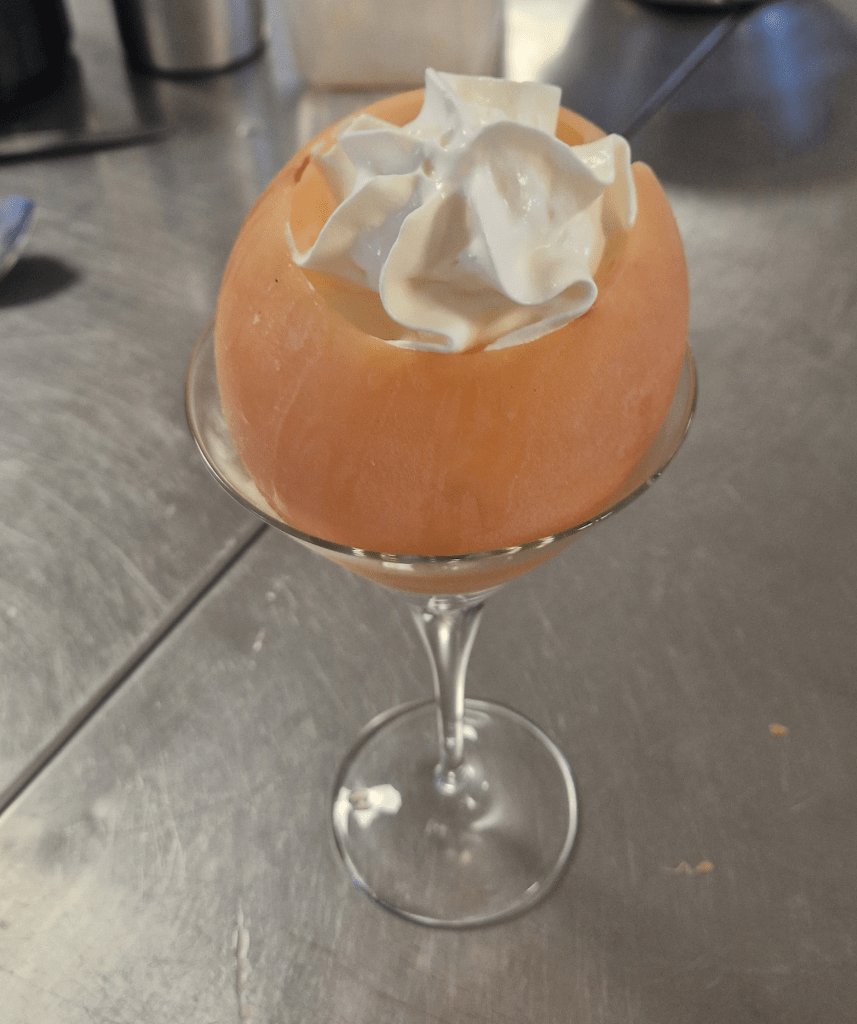
There’s enough for us all to have a taste and more than enough sorbet, ice cream, orange sponge and campari/orange mix to go round as we finish the day with a celebratory glass of champagne.
It’s past 18:30 by the time I’m back at the residence, but various urgent issues mean I need to make a trip to Valréas. I make it there just after 21:00 in time for a late supper with J. And time on Sunday to practice recently learnt skills at home.
 Food in Provence (and elsewhere)
Leave a comment