Today’s classes in both pastry and cooking turned out to be exercises in precision. Our first task in pastry was to cut 10 circles from the vanilla sablé we made yesterday with a 3cm cutter and using the nozzles of size 14 and 10 piping nozzles. Fortunately I followed chef’s instruction to pre-cut the circles, place the pastry in the blast chiller for a minute or so and then press out the circles. Much easier than trying to take circles from the warmed up pastry. Then into the oven to bake for 12-15 minutes. Meanwhile K. made yet another sablé dough, this time with added feuilletine (the cornflake-like stuff we last used in chocolate week).
Then I make a lemon/lime/yuzu mousse akin to that for the lemon meringue tart of last week (so pouring the juices thickened with egg onto butter in a jug and blending) but with added gelatin. This was poured into the almond cream square K. prepared yesterday. I sense another plating exercise tomorrow…
After chef had put some frozen strawberries in a well-wrapped bowl on a bain marie to stew to make strawberry juice, K. cut grapefruit segments while I made an avocado purée with lime juice and olive oil. Then chef a) made a coconut and cream mousse from ingredients K. and I had prepared and b) demonstrated the plating he wanted for the dessert we were preparing. As is not unusual, the latter was accompanied by a commentary on restaurant economics. Desserts, it seems, are profitable for restaurants as their ingredients are, unlike the protein ones for main courses, relatively cheap. And customers don’t feel cheated with an elegantly plated dessert. But elegance is not quite all; the plating below enables a right-handed person (the large majority of customers) to take a bit of the coconut sorbet and some of the avocado, grapefruit and meringue without their hand touching the mousse on the left. So elegance, practicality (no messy hand) and a consideration of flavour and texture contrasts in an a spoonful. And then chef rustled up another plating in a minute or so, one that would be more than acceptable but also profitable (because of the reduced plating time) in a bistro.
Enough said. Here’s my plating. Ignoring the slightly displaced sorbet (I´d had to carry the plate around a bit) and the pisa-like tower of mousse (I apparently didn’t hold the siphon spout perfectly vertical), chef’s criticism was that there were gaps where the avocado crescent should have been covered with something—whether grapefruit, sablé or meringue—to provide a better visual and eating experience for the customer.

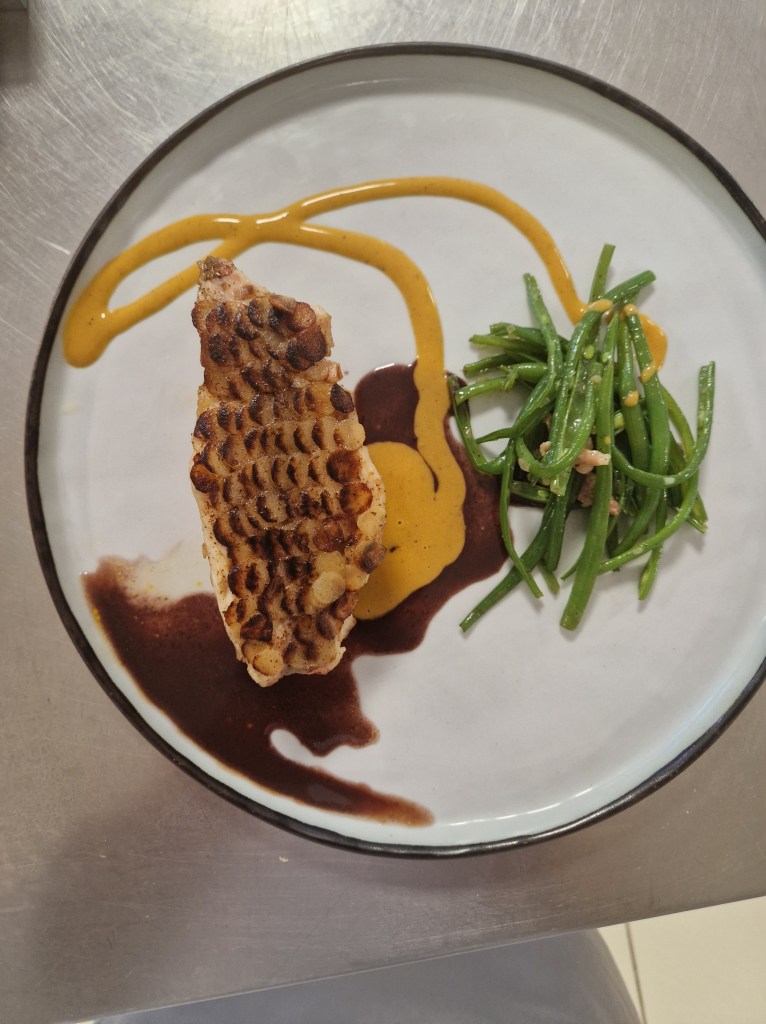
The precision challenge for the afternoon was to present a red mullet fillet with potato scales, emulating a Bocuse speciality. Filleting the fish was a little easier than yesterday, fortunately, and removing the skin (give it a short time on parchment paper in a hot frying pan) wasn’t too hard. Placing the potato scales, though, took a while (the precision test). Then, after a quick blast chill (and some time in the fridge for us during which time we prepared accompaniments of a lentil salad and sautéed green beans) we fried the fillets on parchment paper, took off the paper, then finished cooking the fish whilst basting the potato crust in butter. Simple, no? The hard part is getting the temperature right for the initial frying of the fillets on the potato scales. Too low a temperature and the scales will stick to the paper but won’t brown, too hot and they will burn. I did OK, but chef helped a little with the repositioning of my scales after the initial cooking.
Then the disaster. The early plating went well, but chef had prepared an emulsion from the mullet livers and had boldly swirled this from a squeezy bottle over his sauce and plate. So,I went for boldness without checking that the spout on the squeezy bottle was as small. Lesson learnt. The hard way.
Then the wine class. Not exercises in precision, but rather in taste as we had blind tastings of two white Bordeaux (one priced at €3.99, one at €30) and two St Emilion (one at €15, one at €55). The white tasting was interesting. All of us preferred the cheaper one on our initial tasting but L. and I switched allegiance to the other as it warmed up. Even so, neither of us would have been willing to pay the €30. This, our sommelier said, was a problem with Bordeaux wines; not a fan of the 1855 classification (a lot has changed since then in terms of climate and vinification practices but also the way in which wine is drunk), she considers finding a good wine at a fair price to be difficult. I think we all considered the quality/price ratio to be better for the €3.99 wine than the more expensive one.
After trying a 2018 left bank St Estèphe (too young), it was time to choose between the two St Emilion. Interestingly, opinions were both more split here and more fixed. I preferred the more expensive one as did two of my fellow students with two others preferring the cheaper one. An interesting discussion followed! And a long one so our Sauternes tasting is postponed until tomorrow…
Oh, by the way, the strawberry juice… After an hour or so there was much juice in the bottom of the bowl. Chef poured this and the strawberries into a sieve and let it drain giving us the stern instruction that these should not be pressed, just left for the the juice run out with any flesh left being jettisoned. An alternative method is to seal frozen strawberries (or raspberries, or…) in a vacuum bag, cook them in a water bath at 90°C for an hour and then strain similarly.
 Food in Provence (and elsewhere)
Leave a comment