I’m partnered with K. in pastry so a promising start to a week of plated desserts. We start by having to make a double lot of sablé, divide it in two, flavour one with lemon zest and the other with vanilla powder (finely blended vanilla pods in their last contribution to flavour) and roll each out between plastic sheets. These are as a base for desserts we’ll make later in the week. I work on this while K. prepares and cooks an almond cream, again for later in the week. As more preparation for the future, Chef prepares coconut sorbet. Something I need to remember as we will have to do this next month. J. won’t be pleased as the mix is put in Pacojet containers at the end of the class…
So on to the on dessert we do prepare today: panna cotta. As viewers of Masterchef will know, this is a frequently offered dessert as it is relatively easy. Something Chef acknowledges, but adding also that it can be relatively cheap, especially if milk is substituted for some or all of the cream. Remember, the school is training people to work in (and even run) restaurants; this point will be revisited in the afternoon. Chef promises us, though, something more than a simple offering.
Not surprisingly, we boil almond milk, flavouring it with lemon grass, add gelatin and whisk in softly whipped cream. Chef insists, though, that the almond milk must be cooled to 35°C before the cream is added. See later…
We pour this into bowls and leave to settle for ten minutes or so. As for the petit pot au chocolat, moving it now would create a mark on the plate that would be unsightly. We use the time to chop mango finely and mix it with passion fruit and lime zest and juice (me) and prepare a tuile mix, spread strips on silpat, bake them (all K. so far) and, when they are baked, shape rings (not too hard) and spirals (not easy). Then we plate.
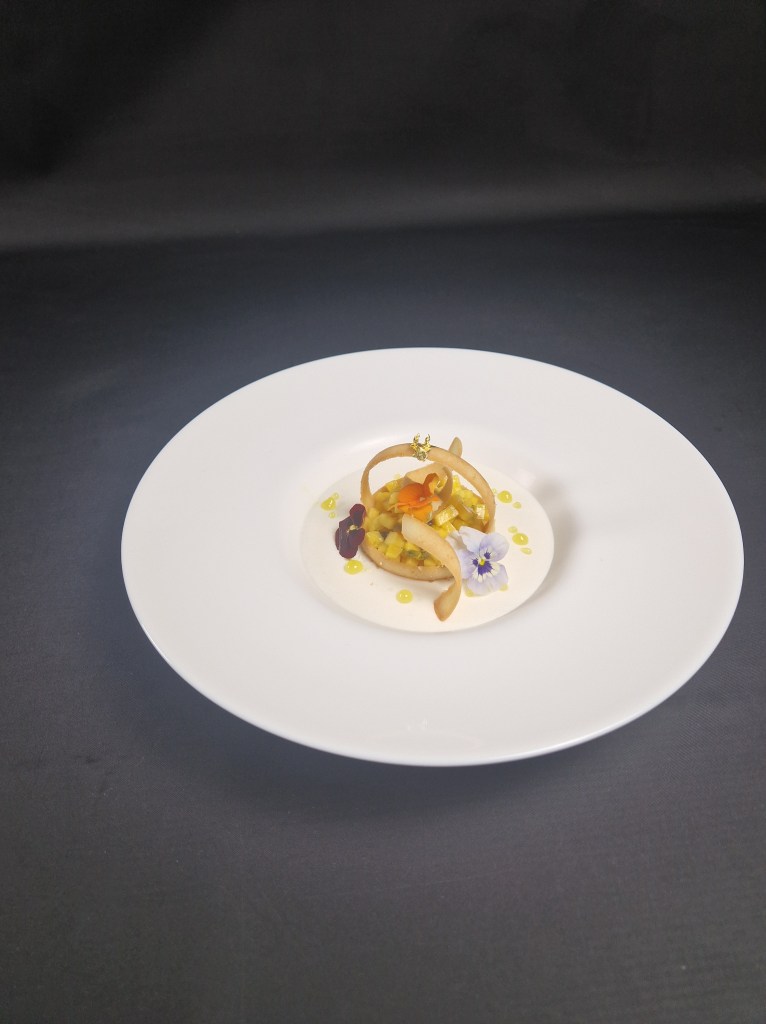
Mine is OK; the major issue is that the croustillant should have been a little more cooked. (The minor issue is that I didn’t manage to hide all the places I dropped mango cubes outside the tuille circle. Chef, of course, spots these…). Then the surprise. Chef shows us that the panna cotta has separated into two layers: a creamy top and a more set bottom layer. This is because we cooled the milk to 35°C before adding the cream. At this temperature, the cream could rise to the top during the 10 minute resting period. Cooling the mix to 25°C would give a result more like a mousse whereas adding the cream with the milk mix at 45°C would lead to a much greater proportion of set milk and a smaller cream layer.
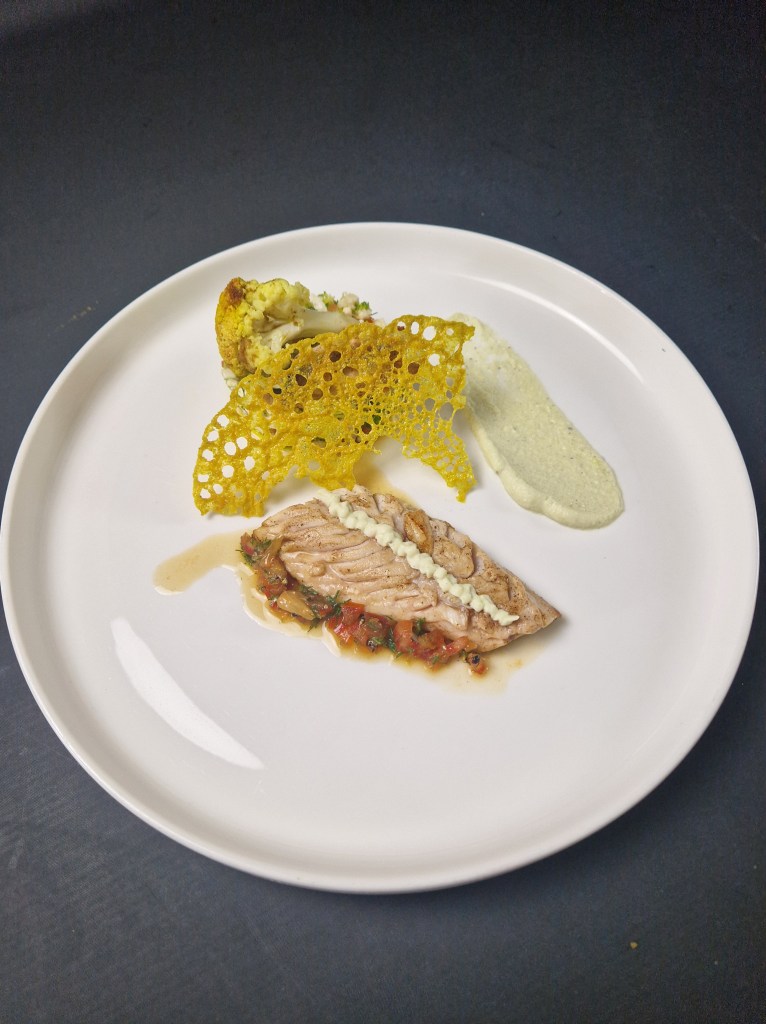
After lunch I also strike lucky as I’m partnered with M.—the returnee from last year, if you remember—although as he’s a rather tall guy we have to move our boards around a couple of times so we can both work at the bench on our different tasks. The first of which is to gut and fillet a mackerel. Chef gives M. a spare one which I take as being because M. is a returnee, not because I’m making a pig’s ear of my filleting. I’m not, although I certainly don’t do such a good job as I did with the sea bass in the first week. M. then prepares and roasts some cauliflower and shreds cabbage and broccoli for a “tabouleh” whilst I prepare a sauce vierge and a tuile mixture.
We then learn yet another method of making tuiles: pour the mixture into a hot frying pan from a squeezy bottle, watch the water evaporate and then shape the setting tuile. Unfortunately, M. and I have a frying pan with a raised middle so our mixture runs to the edges. Switching to a new one gives a better result but we don’t really have a great choice of tuiles for plating. My plating is considered as simple but elegant although I should have placed the mackerel skin side up. That way the customer sees that the skin is on and can choose to remove it. I can confirm, though, that the mackerel was delicious eaten with the skin. But that is my taste. And chef remarks yet again that restaurants need to take into account the differing tastes of their customers.
Also, harking back to this morning, restaurants also need to turn a profit. So much emphasis was placed on leaving as little flesh as possible on the bones and saving what couldn’t be used for a stock. We also turned the backbone of our mackerel into a crunchy accompaniment to the plated dish.
Then it was time for the first of our last three wine classes. We didn’t study a particular region today but tasted some wines blind. The first turned out to be the Drappier champagne that had been corked when we tasted champagnes. The second followed on as it was a Rosé de Riceys from the champagne region. I had provided this without realising that it was from 2018. As it was so old, the bold upfront notes of this rosé that had led J. and I to leave a couple of bottles undrunk had disappeared leaving a rather flat taste.
Then our sommelier challenged us with a blind tasting of a Languedoc chardonnay, a Vaudois chasselas and a Condrieu. Given that I’d provided the chasselas, I’m glad that I recognised it. Everyone else also did, though, although not everyone correctly identified the chardonnay and the Viognier.
Likewise then a blind tasting of the two reds I’d taken, a gamay/gamaret/merlot blend from a Geneva producer and a 100% Mourvedre from Xavier Vignon. Luckily, I again recognised the two correctly!
These tastings were very interesting as our opinions of the wines changed over time as they warmed. All the whites were somewhat underwhelming at the initial temperature but improved as they warmed but the Viognier then suffered once it had warmed too much (the Chasselas, though, was better even at that warmer temperature). Similarly, opinions of the two reds changed; although the 100% Mourvedre was generally preferred, opinions of the Geneva wine improved over time and it became the favourite for some.


 Food in Provence (and elsewhere)
Leave a comment