To celebrate and honour craft skills, France organises a competition for the “Meilleur Ouvriers de France” every three years or so. The wide range of disciplines includes, of course, cooking and pastry work and the title is prestigious: chefs with this award proudly wear a blue, white and red collar on their jackets. One such is David Alessandria, a laureat from the 2023 competition, who is at the school for the next two days to give us a cookery masterclass.
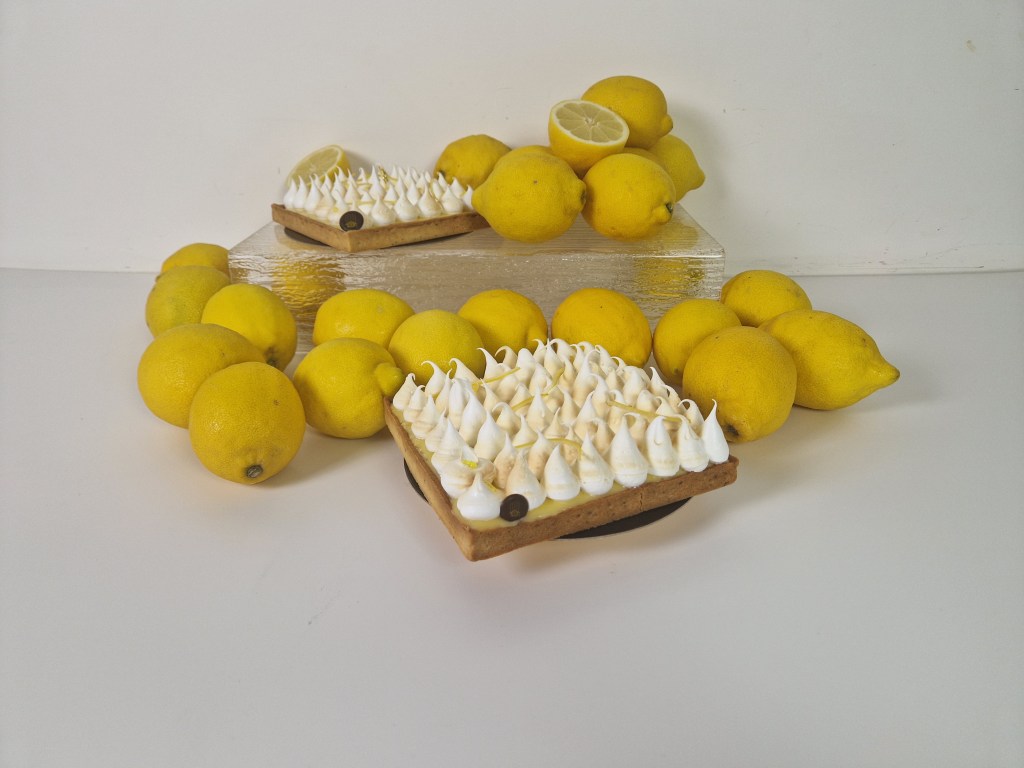
But, first, we have to turn the pastry we prepared yesterday into a lemon meringue tart. As it’s the second month, things are harder and so we have to fit our pastry to a square mould. The general technique is the same as we learnt last month but there are more angles to deal with—and a warning from chef that we need the sides to be well done so we can have enough of the lemon curd filling. Making that is relatively easy but novel in that we pour a sort of custard onto butter in a jug and blend everything together. Then, though, we have to make an Italian meringue, something I haven’t done before.
Heating the sugar and water while I watch the egg whites as they whip, trying to reach the required temperature and whippedness at the same time is a little nerve-racking but I seem to manage and chef seems happy enough with our piping bag full of meringue. I don’t, though, manage to emulate chef’s perfect 6×6 square of meringue blobs, ending up with a 7×8 rectangle (on a square tart…), but my blobs are a respectable height and most have a nice peak. Then we have to brown them. Chef doesn’t use a blow torch for this but rather a heat gun, explaining that there’s no risk of any burnt meringue this way. As I used a hair dryer rather than a heat gun when preparing the chocolate sablé biscuits at home during the holiday, I wonder if the same substitution would work for this… Leaving aside the issue of burnt meringue, the undoubted advantage of a heat gun is the sight of the meringue peaks dancing about in the stream of hot air!
Given a judicious choice of viewpoint (we are supposed to position the chocolate logos to guide the eye, after all), most of the imperfections in my piping can be hidden. And, anyway, the true test is in the eating, no? I certainly had no complaints with the piece I ate for my goûter.
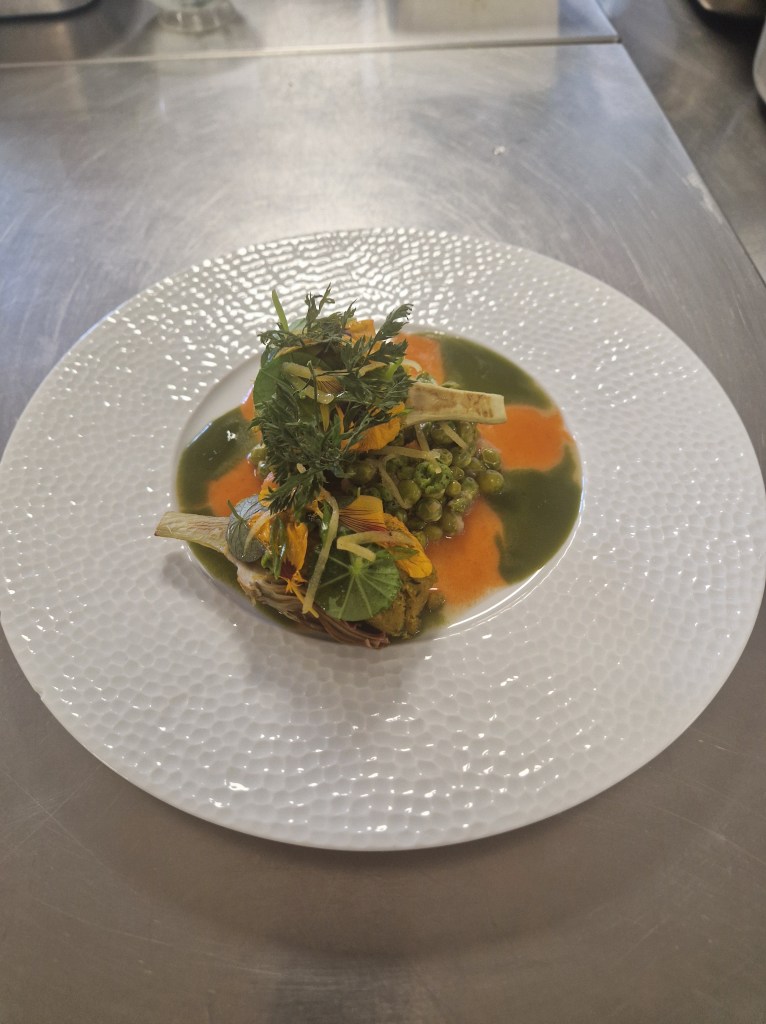
And so to the cooking masterclass where the recipe of the day is for Artichaut Clamart, an updating of an Escoffier recipe—and, what’s more, a vegan no-waste recipe. Pea pods are used to make a juice for one of the sauces and the pulp from carrots used to make juice for the other sauce are used as the base for a stuffing for the artichokes. And everything is cooked using oil, not butter, even if our usual chef favours using butter to ensure we get a good caramelisation when browning ingredients.
As our temporary chef likes nasturtiums—for their peppery taste—we have a pea purée flavoured with nasturtium leaves and use nasturtium leaves and flowers for decoration. We also learn to make lemon zest intensely lemony (a technique we can apparently use for other citrus zests) to give added flavour to the finished dish.
There are a lot of cheffy things going on here but we have an extra hour for the lesson and our usual chef is quite pleased that we finish both the recipe and the cleaning in good time!
 Food in Provence (and elsewhere)
Leave a comment