Our first task today was to make a chocolate sablé. We did this last week to create a decoration for our chocolate fondant, using cold butter and rolling the sticky dough between plastic sheets. Today, chef wants a pipeable dough we can use for biscuits so the butter needs to be really soft before adding the sugar and then the flour. I think I’ve mentioned my partner this week likes piping so D. gets on with this whilst I temper 800g of chocolate. I set about this with some trepidation but make less of a mess on the bench as I stir round the chocolate to cool it down. Then comes the crucial test: we have to dip into the tempered chocolate the milk chocolate and hazelnut cream mixture we prepared on Monday and chablonné´d yesterday (gave it a thin layer of chocolate) before cutting it into small squares. We have to lower the squares into the chocolate with a special fork, use the fork to scoop over the chocolate and then, having drained off the excess, place the result on parchment paper. Chef warns us that if the coating on the first dipped square hasn´t set by the time we’ve dipped the sixth then the tempering hasn’t been done well. To my delight the coating on the first is setting whilst I’m dipping the fourth!
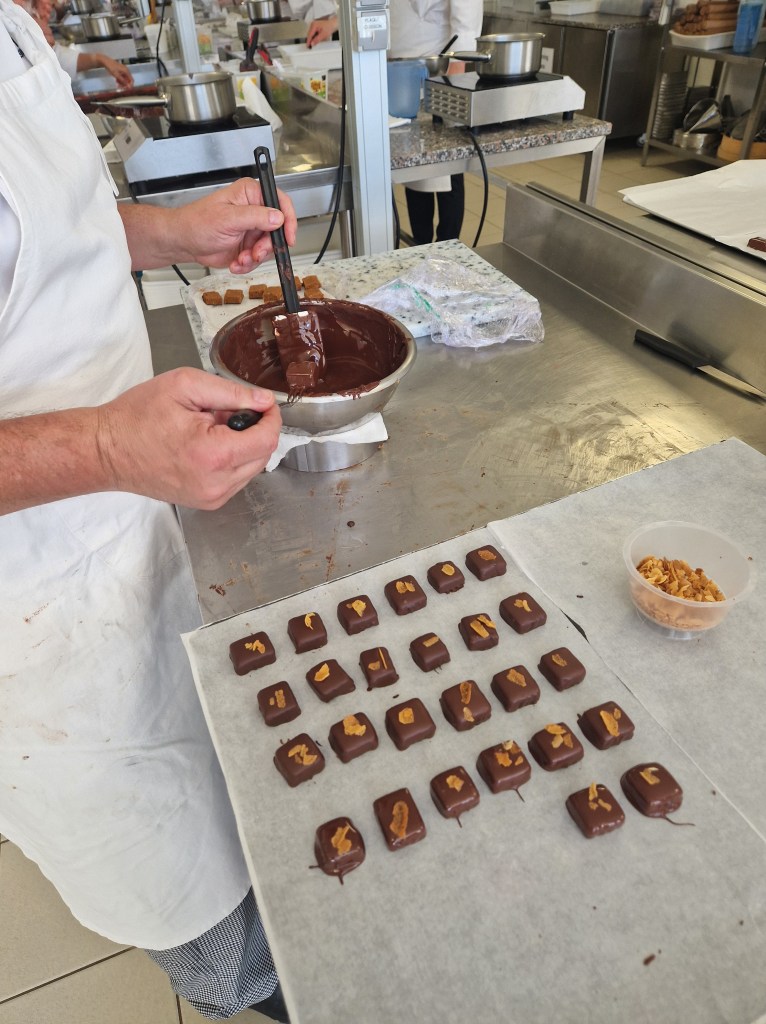
D. does the second row of six but as the next task is to pipe chocolate as a layer for our newly baked and cooled sablé, she does the piping while I complete the rest. Then we coat the ganache we made yesterday in chocolate—me with the messy task of coating them by hand (wearing gloves, fortunately)—and icing sugar—D., flicking them casually around with the fork. The end result is a lot of chocolate goodies for J. and N. when they visit this weekend. And a lot of cleaning up before lunch…
And so to cooking class where we have to prepare blanquette de veau à l’ancienne, légumes tournés, oignon grelot glacé, riz pilaf. After boiling it to get rid of the scum, we simmer the veal with some vegetables for 45 minutes or so whilst we learn to turn our vegetables. Chef has us practicing with an egg: holding and rotating this in one hand as we move the knife over the shell with the other is good practice for the movements we need to make with our courgette pieces (soft and easy), carrots (hard and harder) and turnip (harder and harder still). I didn´t take a picture of my turned veg but I think I did quite well.
After we’ve rescued our simmered veal, C., who enjoys making sauces, prepares a roux and whisks in most of the remaining stock whilst I cook the rice in the remainder. Then to plating. Chef has not much to say which I take as a good sign.

As usual, much cleaning is involved. As a practical detail, there are sinks at either end of the classroom so each half of the room—four tables, eight trainee chefs—washes their pans, containers and the like (preferably as we go, but a lot gets left to the end). Utensils and, above all, knives, though, are washed and dried in a central station and I’m one of the team there today.
Sadly, the session on Rhone Valley wines starts badly. After a couple of introductory videos, I’m handed a Condrieu to open and serve. Having smelt the cork, though, I serve only our sommelier who is devastated as she has to agree that this is the second corked bottle she has provided. Fortunately the reds (an Hermitage and then a Châteauneuf du Pape) are OK although my poorly phrased criticism of the second is judged to be correct: it doesn´t have the right balance of acidity to alcohol and tannins—it is too acidic. But it improves as we sit round discussing it and the bottle gets finished somehow…
There is then a new twist on the “name that aroma” game. We haven´t had many of the little phials on the table tonight so it’s not a game of “match that scent to something you smelt earlier” but rather a sterner test of identifying scents, And I prove rather poorer at this version of the game, coming fourth and last… Let’s hope this isn´t an omen for tomorrow’s written pastry test!
 Food in Provence (and elsewhere)
Leave a comment